
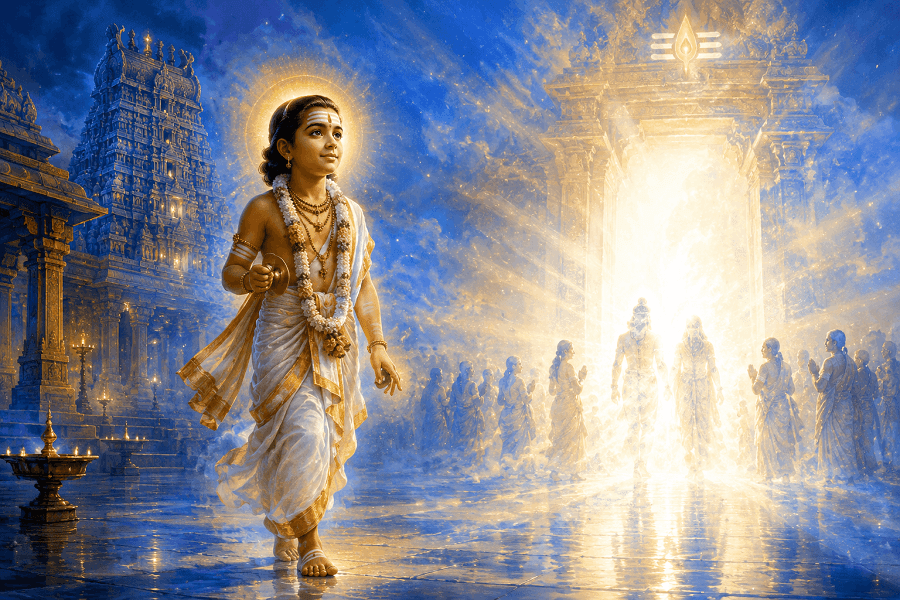
The story of a sixteen-year-old Tamil saint who, according to Shaiva tradition, merged into the Light of Shiva
There are stories of enlightened beings throughout the spiritual traditions of the world. Some speak of awakening, some of liberation, and some of union with the Divine.
The story of Thirugnana Sambandar, one of the great Tamil Shaiva saints, is one of the most extraordinary.
Sambandar was born in Sirkazhi, Tamil Nadu, and is traditionally believed to have lived during the seventh century. He was one of the 63 Nayanmars, the revered Shaiva saints of Tamil tradition, and one of the three principal authors of the Tevaram, sacred hymns devoted to Shiva.
Enlightened From Childhood?
According to the traditional story, when Sambandar was only three years old, he received the divine vision of Shiva and Parvati at the temple tank in Sirkazhi. Parvati gave him sacred milk, traditionally understood as Jnana Paal—the milk of spiritual knowledge. Immediately afterward, the child began singing profound hymns in praise of Shiva.
Some spiritual interpretations go further, suggesting that Sambandar’s realization was not something newly acquired in that lifetime. Rather, he was already established in higher consciousness and simply awakened to what he already was.
Perhaps this is why his story feels so different from the conventional idea of a spiritual seeker gradually becoming enlightened.
A Life of Devotion
Although only a child, Sambandar traveled extensively, composed devotional hymns, and became an important figure in the revival of Shaivism in Tamil Nadu. His association with Madurai is particularly significant, where tradition tells of his encounters with Jain monks and his role in restoring the Shaiva tradition.
Yet his story was remarkably brief.
He lived only sixteen years.
Merging Into the Light
At sixteen, Sambandar’s marriage was arranged at Nallur Perumanam. After the wedding, he entered the Shiva temple with his bride and those who had accompanied them.
According to the traditional Shaiva account, a great effulgence, Shiva Jyoti, appeared.
Sambandar sang a final hymn and invited those present to enter the Light. His bride, devotees, family, and others entered with him, and they were said to have merged into the Shiva Jyoti.
This is a sacred traditional account, not something that can be historically verified as a physical disappearance. Yet within Shaiva tradition, the event represents something much greater than an unusual ending to a young life: union with Shiva, the Divine Light.
What Does Sambandar’s Story Say About Living the Light?
We cannot know exactly what Sambandar experienced.
But his story invites a profound question:
What if enlightenment is not becoming something we are not, but recognizing what we have always been?
This is at the heart of Living the Light.
The Light does not need to be created. What covers it may need to be recognized, understood, completed, and released.
Sambandar’s life offers a powerful image of this realization carried to its ultimate expression—not merely seeing the Light, but merging with it.
For us, Living the Light does not require extraordinary experiences. It can begin here and now: through compassion, love, witnessing our emotions, forgiveness, generosity, trust, and the gradual release of the coverings that keep us from expressing our deepest nature.
Perhaps we do not need to wait for enlightenment to begin living as the Light.
We can begin now.
Source/reference: Thiru Jnanasambhandar – Nithyanandapedia